
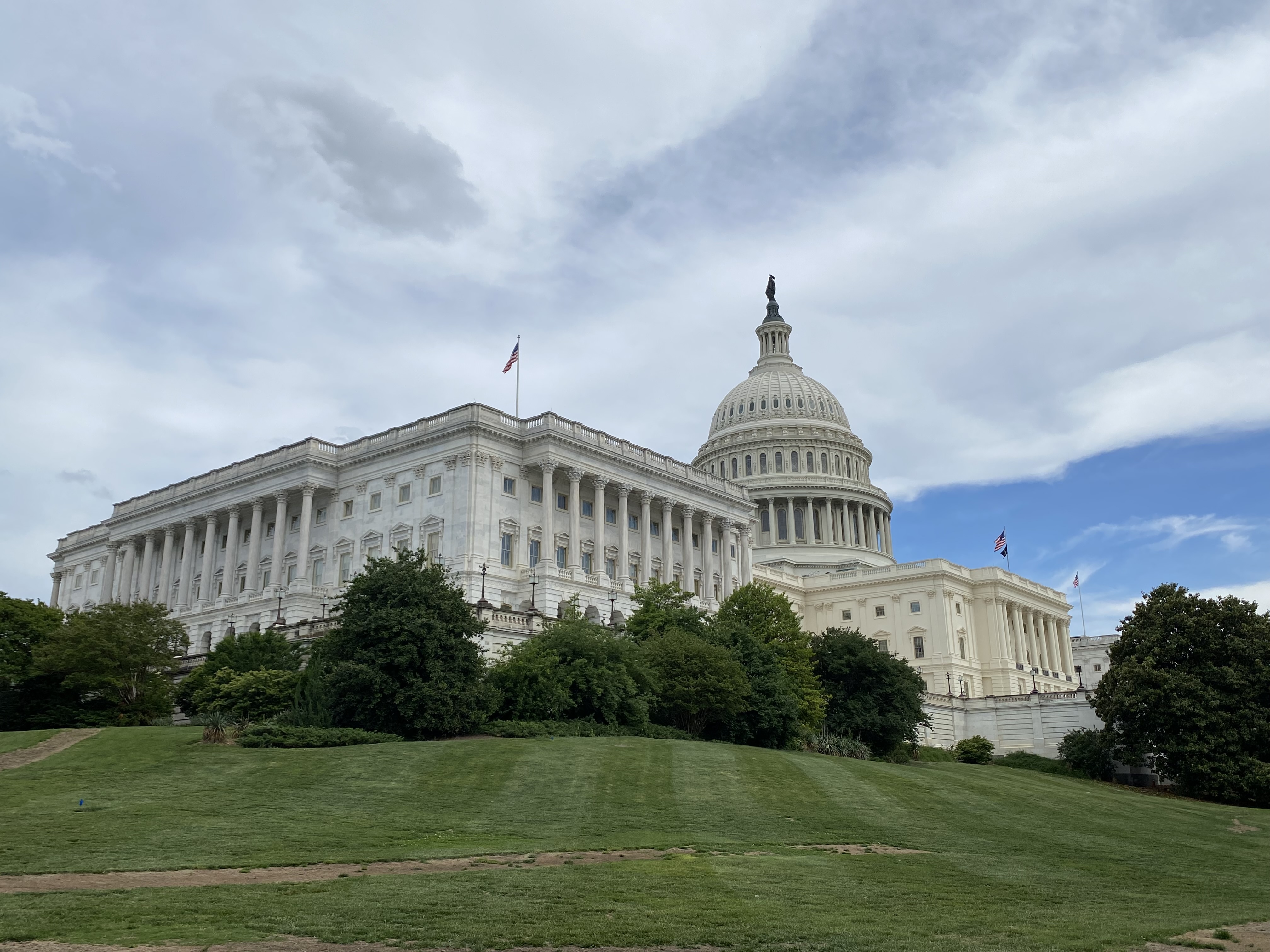
The U.S. Capitol on May 7, 2025. (Photo by Jennifer Shutt/States Newsroom)
WASHINGTON — Democrats expect they’ll gain a majority of seats in the U.S. House following November’s midterm elections, giving the party a platform to serve as a check on the president’s power.
Democratic Congressional Campaign Committee Chair Suzan DelBene said during an interview Monday that curbing the war in Iran and working on legislation to address the costs of healthcare would be at the top of the party’s agenda if it is able to flip that chamber.
“And of course, act as an independent branch and do our job to hold the administration accountable,” she said.
The Washington state Democrat said she views Republican super PACs spending millions of dollars in safe GOP districts as a sign that voters are moving toward Democratic candidates.
“We've seen MAGA Inc. pour millions into House races and spending deep in red territory. Of the 38 districts that MAGA Inc. is spending in so far, 26 are on defense,” DelBene said, referring to the president’s super PAC. “And the speaker and the majority leader were campaigning recently in districts Trump won by double digits in 2024.”
The DCCC announced earlier in the day that it had added six candidates to its “Red to Blue” program — Chris Jones in Arkansas’ 2nd Congressional District, Dwayne Romero in Colorado's 3rd Congressional District, Eliott Rodriguez in Florida's 27th Congressional District, Teresa Benitez-Thompson in Nevada's 2nd Congressional District, Blake Gendebien in New York's 21st Congressional District and Justin J. Pearson in Tennessee's 9th Congressional District.
The additions bring the DCCC’s targeted House races to a total of 46.
DelBene said during the interview with States Newsroom and other journalists in the Regional Reporters Association that “while Republicans seem to have infinite amounts of money to throw at us, our momentum is simply too strong to stop.”
“Republicans may have more money, but they have zero substance,” she said. “We know we don't need to spend more, but we do need to spend enough.”
National Republican Congressional Campaign Chairman Richard Hudson, of North Carolina, wrote in a statement released Sunday that with less than a month to go until voting ends on Nov. 3, GOP candidates “are on offense.”
“We’re competing in districts Democrats swore were safe. We’ve recruited candidates who served in uniform, built businesses, and put criminals behind bars,” he said. “And we’re running on results: lower taxes, a secure border, and an economy that works for working families.”
The Cook Political Report with Amy Walter categorizes 197 House districts as solid or likely Democratic and another 195 as solid or likely Republican.
That leaves voters in 43 districts throughout the entire country to determine whether the House remains in Republican hands for another two years or shifts to Democratic control. Of those, 11 are rated as leaning Democratic, 10 are leaning toward a Republican candidate winning and 22 are true toss-up seats.
The magic number for House control is 218, though every additional seat beyond that threshold makes governing much easier for party leadership.
Speaker Mike Johnson, R-La., has had to consistently balance the demands of moderate and far-right members to move legislation across the floor. The House majority currently sits at 218 Republicans, 214 Democrats, one independent who used to be a Republican and two vacancies.
Erin Covey, editor for the House of Representatives at Cook, said on the “Stories from the States” podcast that during the last month or so “the overall political environment has really solidified to favor Democrats."
“At this point, our estimation is that Democrats will likely end up with around 220 to 230 seats at the end of the day,” she said. “Of course, that would be a majority in all of those cases. But on the lower end that would be a pretty slim majority. Some of that is because the battleground of competitive districts is relatively small compared to previous cycles. And so the number of truly vulnerable seats that Democrats can pick up is capped in a way it wasn’t in 2018, for example. But the national political example is just as good as it was for Democrats in 2018.”
Courtesy of D.C. Bureau


