
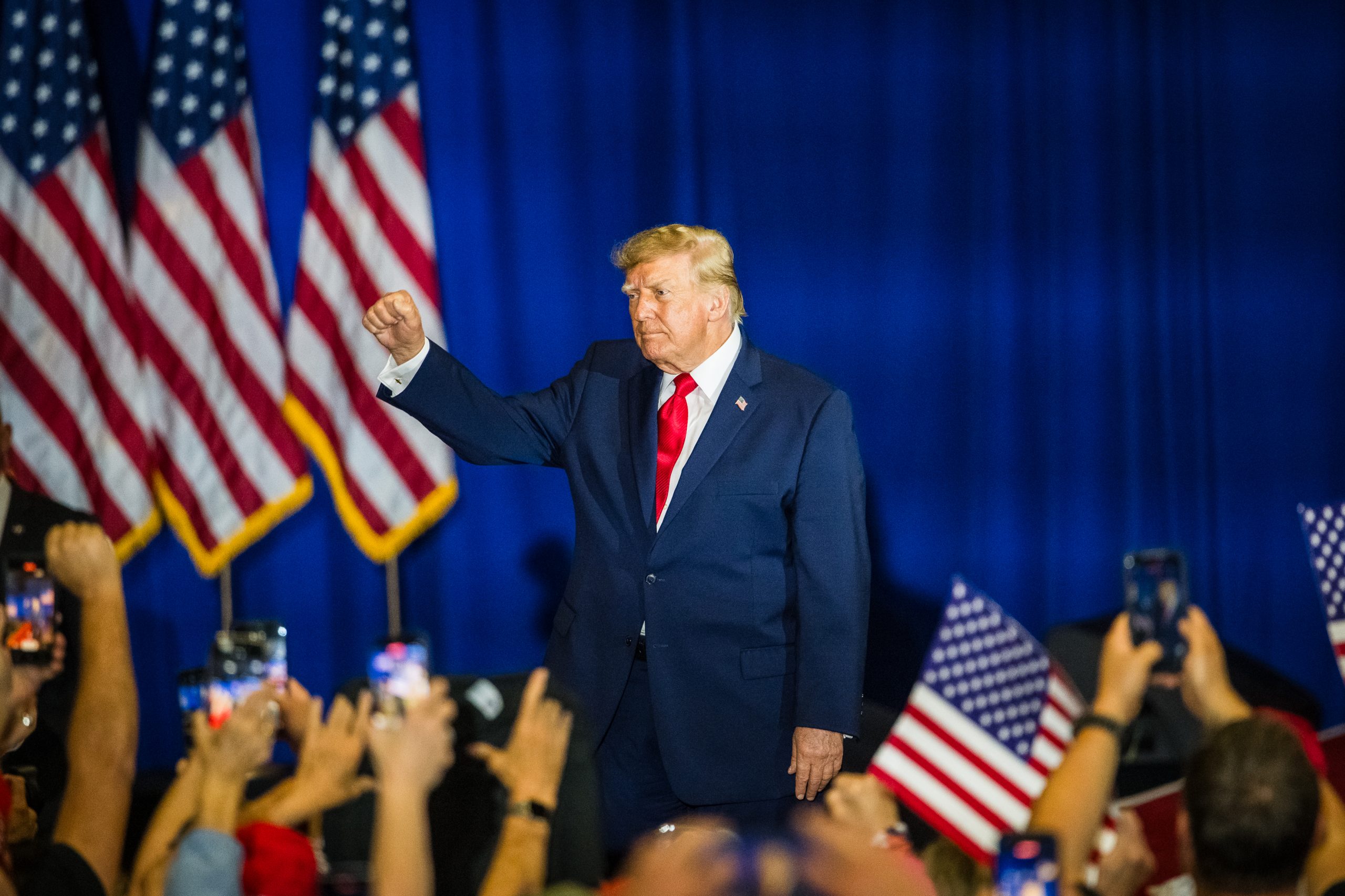
President Donald Trump gestures as he exits the stage during a midterm election rally at the Choctaw Event Center on Oct. 1, 2026, in Durant, Oklahoma. (Photo by Jessica Tobias/For Oklahoma Voice)
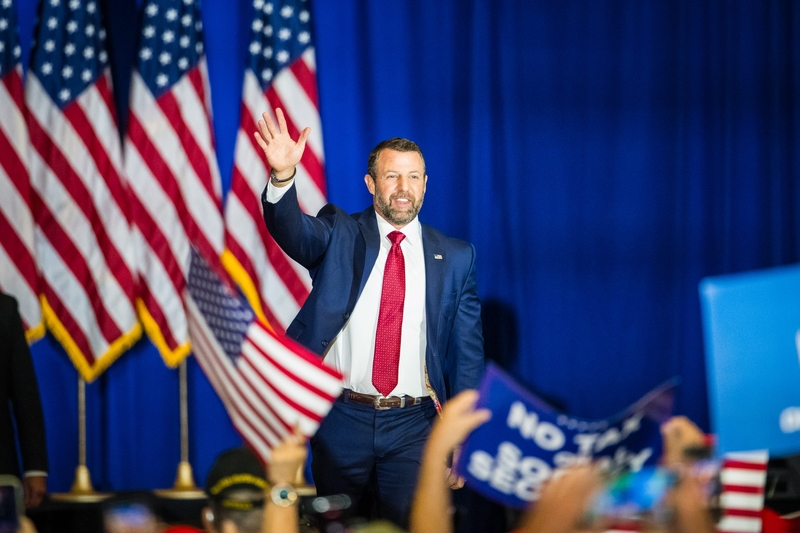
When Homeland Security Secretary Markwayne Mullin declared in September that Immigration and Customs Enforcement could serve warrants on individuals at polling places this fall, officials in Denver, a liberal city where roughly 14% of residents are foreign-born, quickly sued.
“Every day we find new things to be astonished about but I think that we just want residents to not be afraid to vote because that’s ultimately what the president was after,” Denver Mayor Mike Johnston, a Democrat, said in an interview.
Johnston and other local and state officials across the country are bracing for possible federal election interference from now through Nov. 3 — even as they remain unsure of what will actually happen.
One month from Election Day, President Donald Trump’s long-running pressure campaign over elections is approaching a decisive moment. For the past year, the Trump administration has sought to bend the U.S. election system to the president’s will across multiple fronts, despite the Constitution’s guarantee that states administer elections.
Interviews and public comments by more than a dozen current and former election officials, legal experts, lawmakers and others ahead of the midterms reveal anxiety over what Trump may do. Election administrators often plan for natural disasters, bomb threats and other possible problems, but this year many are also thinking about possible disruptions driven by the federal government.
Potential scenarios range from armed federal personnel deploying at or near the polls to Trump declaring a national emergency — ideas widely condemned as illegal by election law experts. Homeland Security denies it plans to specifically target polling locations.
Others include efforts to discredit voting machines or federal law enforcement obtaining search warrants to seize ballots, a fear that’s grown since the FBI took 2020 election ballots in Fulton County, Georgia, earlier this year.
Barb Byrum, the country clerk in Ingham County, Michigan, which includes much of Lansing, said that when she became a clerk 13 years ago, she and other officials conducted table-top exercises to plan for power outages and tornadoes. Now it’s moved on to “federal misbehavior,” she said.
“It’s really unfortunate that’s where we are. But that is, in fact, where we are,” Byrum, a Democrat, said in an interview.
Fears of election interference are at least partly rooted in previous efforts by Trump and his allies to overturn his 2020 election loss in key swing states, culminating in a mob of his supporters storming the Capitol on Jan. 6, 2021. The riot led to Trump’s second impeachment in the House on a charge of inciting an insurrection, but the Senate acquitted him.
Nearly six years later, Trump’s approval ratings are sagging and Republicans are fighting to retain control of Congress amid encouraging polling for Democrats. Loss of the House or Senate would effectively end Trump’s legislative agenda and lead to investigations that consume his final two years in office.
“A desperate Trump is a dangerous Trump,” California Attorney General Rob Bonta, a Democrat, said during an appearance at the progressive Center for American Progress in September.
At the same time, Americans’ trust in elections is eroding. Just 49% of respondents said they expect the midterm elections to be free and fair, according to a national survey of more than 5,000 adults in early September conducted by the University of California San Diego Center for Transparent and Trusted Elections.
Still, election officials and legal experts remain largely confident any interference effort ultimately won’t succeed. The United States has a decentralized election system run by state and local officials that guards against large-scale efforts to steal elections or prevent voting, they say, predicting courts would swiftly rule against the deployment of federal agents.
Many votes are also cast by mail, sidestepping any Election Day show of force. More than 1 million votes have already been cast, according to data compiled by the University of Florida’s Election Lab.
“It’s not going to happen,” David Becker, executive director of the nonpartisan Center for Election Innovation & Research, told reporters on Tuesday. “You’re not going to have to run a gauntlet. You’re not going to see troops or armed individuals at the polls.”
Trump and his aides refuse to flatly rule out interfering in the midterms. In an interview with TIME magazine published Thursday, Trump declined to take extreme measures off the table. Asked about sending ICE to the polls, he said only that he hadn’t thought of it.
“I don’t rule anything out or in. We’ll see,” Trump said of a national emergency.
Defense Secretary Pete Hegseth has dismissed questions about sending troops to the polls as “another gotcha hypothetical,” though the Department of Defense has said it has no plans to deploy active-duty troops or federalized National Guard members.
Some Republicans have suggested they would welcome the presence of soldiers if state and local authorities want them. “If that’s something that they decide that they need to look at, then that’s fine with me,” Rep. Mike Collins, a Georgia Republican, told reporters in September.
Mullin, the Homeland Security secretary, last month sought a Department of Justice investigation into whether ballot tabulation machines that read barcodes or QR codes comply with federal law, raising concerns that the Trump administration could create a pretext to dismiss the validity of some ballots.
The Georgia State Election Board’s executive director recently called on the DOJ to potentially intervene in the state over the use of QR code-based tabulation.
Earlier this year, Mullin also warned that election officials who don’t “participate in securing the elections” could face prosecution. He promised to “hold election officials accountable.”
But with Election Day nearing, Trump has been stymied on every major initiative to influence the election process this year:
The White House did secure a recent victory when the Supreme Court allowed states to use a supercharged version of a Homeland Security computer program that can identify possible noncitizen voters. But the decision will have minimal impact on the midterms because, under federal law, it’s too close to Election Day for most states to purge large numbers of voters off their rolls.
In response to questions from States Newsroom, White House spokeswoman Lauren Bis in a statement accused “extreme liberal Democrats” of preventing Americans from having full confidence in their elections by not supporting the SAVE America Act, though the legislation faced bipartisan opposition in the Senate.
“President Trump is absolutely right: we fix this now, or we lose our country,” Bis said.
Trump’s failure to advance his signature election-related policies has left him with few options to exert control outside of increasingly audacious and potentially illegal options. So when Mullin said that ICE can execute warrants at polling sites, the remarks provoked a swift backlash from voting rights activists and Democrats.
“The only reason why we would be at polling places is if there is a threat to that polling place or we’re serving a warrant on someone that we have been actively tracking down,” Mullin said during a news conference on Sept. 1.
On Friday, Homeland Security sent an unsigned statement to States Newsroom denying any plans to target polling locations, adding that Mullin has answered the question “dozens of times.”
DHS said ICE agents are part of trained special response teams that can rapidly respond to major incidents if necessary to aid local law enforcement, regardless of location.
“Any ‘anxiety’ among election officials is the unfortunate result of fake news reports of ‘federal interference’ despite the Secretary’s numerous clear statements to the contrary,” the DHS statement said.
Notably, the statement does not address Mullin’s remark about serving warrants.
At least three lawsuits seek to block any possible deployment of federal agents to election sites. The oldest case, filed on Sept. 10 by Denver and several voting rights groups, points to Mullin’s comments and alleges ICE has already conducted law enforcement operations at polling places this year.
ICE agents “swarmed” a parking lot of an active polling site in San Antonio in May to detain someone, the suit says. In June, agents visited a Ventura County, California, polling place and accosted an election worker at a Syracuse, New York, polling place, it says.
Tina Barton co-chairs the Committee for Safe and Secure Elections, a nonprofit group that helps elections and officials and law enforcement think through how to protect election workers and voters from violence, threats and intimidation. She said the organization has about 138 events on its calendar this year, compared to 67 in 2024.
In communities with concerns about a possible federal presence, the organization has officials work through a scenario involving ICE activity near a polling place that affects voters coming to the area, allowing local leaders to think through questions about what their legal options would be, how they would respond and what they would tell the public.
“Their conversation and how they choose to move forward, that’s owned by them and their community and how they choose to handle that. What we encourage is relationship-building ahead of time with them, conversations ahead of time,” Barton said.
Local election officials receive an “incredible” amount of training in how to handle crises, said Kamryn Hoadley, who advises Michigan election officials for Keep Our Republic, a pro-democracy nonprofit. “They are truly as prepared as somebody could be for anything that will happen on Election Day,” Hoadley said.
In Los Angeles County — the most populous county in the country, with more than 10 million residents — election officials have studied the potential for disruptions to the election.
But Dean Logan, the Los Angeles registrar-recorder/county clerk, emphasized in a statement that scenarios concerning federal agents at polling sites and the seizure of ballots haven’t occurred in his area and haven’t been upheld in court.
“We've engaged in scenario and tabletop planning with our partners so that if an unexpected situation arises, roles are clear and our response is calm, coordinated, and focused on voter access and participation, rather than politically reactive,” Logan said.
“Voters should know the behind-the-scenes work is thorough, and the fundamentals of a secure election are sound,” he said.
Courtesy of D.C. Bureau


